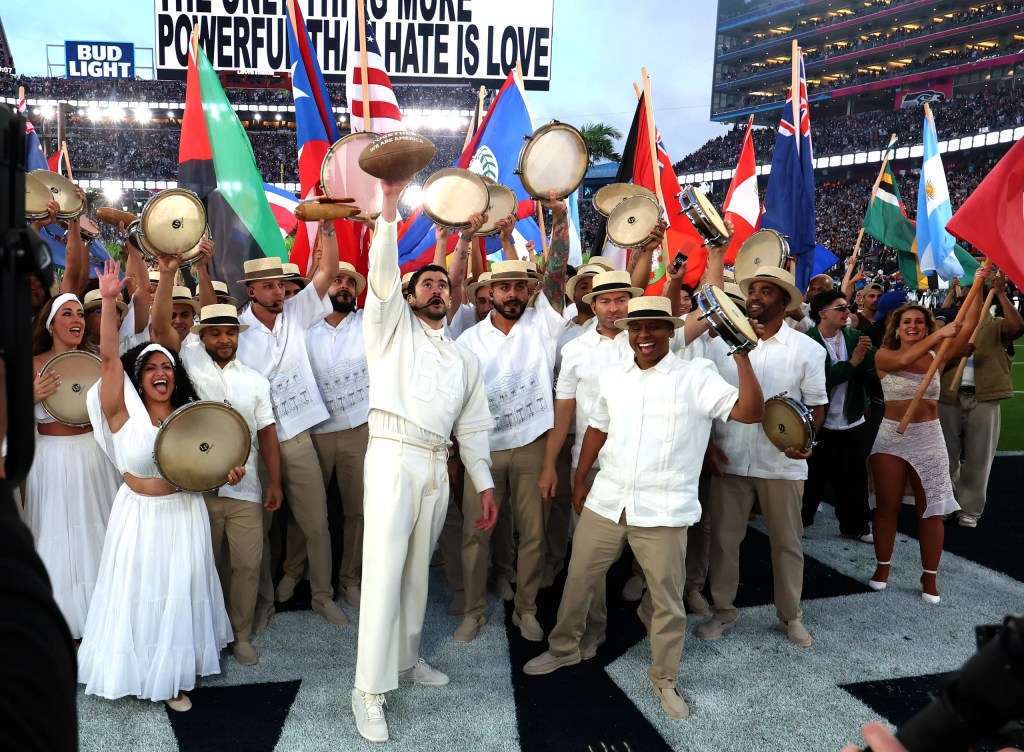
As soon as Benito Antonio Martinez Ocasio walked onto the field last night with the name Ocasio splattered across the back of his jersey, I knew this was going to be deep and demanded my full focus.
Ocasio is a choice. In most Latino traditions, the second last name refers to the maternal parent and his choice to lead with that wasn’t an accident. In a recent interview, Benito choked up when he spoke about the important role his mother has played in his success. She’s been his number one fan long before there was a reason to be his fan, and if you’re Latino you get it – your mama is everything and honoring her in that way to start off a monumental performance that represents the peak of his story (so far) was the best tribute you can imagine. So many of us First Gen high-achievers can relate – my moment came in 2014 when my mom and dad walked the stage with me when I graduated from UC Berkeley.
This performance is a masterclass in the art of storytelling. Of course, so much has been made of the powerful way it tells the story of Benito’s people, the Puerto Rican culture, the history of the island that raised him, but I want to focus on how such a specific story manages to land universally.
Latin America is a diaspora united under a handful of cultural and historical commonalities, many attributed to Spanish colonialism – most notably the Spanish Language – but differ significantly from country to country. Our music, our food, our festive traditions vary. Yet, we still inexplicably feel connected when we interact with Latinos from other places. Why? Because our stories differ in details, but not in heart and energy.
Benito’s performance tells a story so personal and specific of Puerto Rico as seen by a Puertoriqueño that it becomes universal. That’s the power of good storytelling. Good stories are detailed enough to highlight viejitos playing dominos and jíbaros in traditional straw hats, and that specificity allows a consumer to find themself. Who among us doesn’t have an image in our memories we can relate too? I pictured the viejitos gathering to people watch and drink coffee around the plaza in my parent’s hometown, and the farmers heading out at the crack of dawn to the fields surrounding the río to tend to cosecha de nueces and feed the ganado.
We all have culture; we all have traditions. We all have tiny, seemingly inconsequential, memories that bring out nostalgia and connections that are fundamental to our identity. What Benito did on that Super Bowl stage stroked all of those memories at the same time. That’s what made it so powerful. That’s why so many of us are responding in a visceral way. I watched that entire performance and still needed more at the end of it because, although I am not Puerto Rican, I could see myself and my people reflected in his story which created a feeling of validation and pride I rarely get to feel in mainstream media.
The story his performance told was not overtly political – he didn’t need to restate what he’s already said – but it was political because it elevated history and generations of oppression and abuse in a way that didn’t make the negative aspects the focal point. Despite years of erasure and victimization, Latino people can choose to push forward a different dominant narrative that centers joy and achievement.
Bad Bunny has been the most streamed artist globally 4 of the last 6 years. Latino artists in general are on the rise and that shift in power is driving social trends. Their break into mainstream culture isn’t a coincidence. It’s the culmination of decades of work by artists that came before them – Ricky Martin, who joined Benito on stage to perform the beautifully loaded song Lo que le hicieron a Hawái, included.
Benito’s performance is an intentional attempt to re-frame the victim narrative that’s been put on Puertoriqueños, and Latinos for centuries. We get to choose how we move forward into the next chapter, and it can be done with hope and joy and love. What’s more, he does this in a way that doesn’t erase all of the strife that has come before it – he honors it, because he knows that your story is shaped by the past, even if the future is shaped by you.
This moment is especially significant right now as the Federal Administration in the US continues to scapegoat and target Latinos living in the states, regardless of legal status. It’s easy to be so scared by the images we see on screens of people beaten, dragged, and murdered for being brown, and make ourselves small, but Bentio reminds us that fear should never keep us from being our whole selves, with love. It might just be what the world needs. Como dice Benito, “The only thing more powerful than hate is love.”
Photo credit: Vanity Fair
 Storytelling con Marissa
Leave a comment